Views: 0 Author: Site Editor Publish Time: 2026-10-08 Origin: Site


Most investors read through our equipment documentation and ask a very natural question: if all these certificates are in place, can the venue open?
The answer is usually: not yet.
That is not to say the certificates are unimportant. It is that what a certificate proves and what a local authority wants to see are often not the same thing.
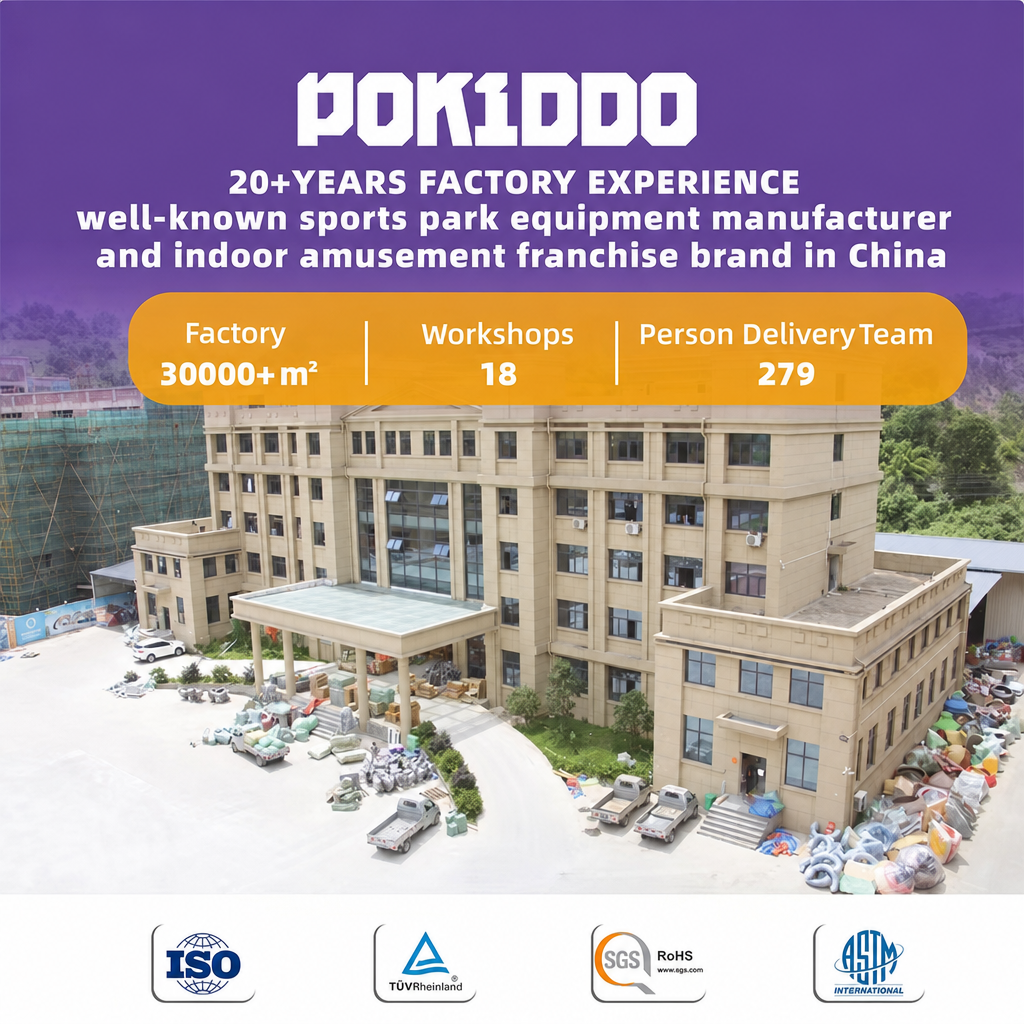
Pokiddo is an indoor playground manufacturer that also designs, builds and operates its own parks. Because we sit on both sides of that line, we have learned to treat indoor playground certification as a starting point rather than a finish line.

● A certificate proves the product; it does not make a project compliant.
● Product compliance is a necessary condition for project compliance, never the whole of it.
● Indoor playground standards differ by market, and a document accepted in one country may not be enough in another.
● Indoor playground safety questions such as ceiling height, escape routes, fire compartmentation and electrical load are project-level, and no test report answers them.
● Documentation has to cover the whole chain, from raw materials through installation and safety checks.
● Final requirements always rest with the local authority and the third-party testing bodies.
A test report proves that the unit submitted for testing meets a particular standard. It does not tell you whether a park can open.
Whether a commercial indoor playground can open depends on far more than the equipment on the drawing.
Is the site approved for that use?
Is the ceiling height sufficient?
Do escape routes, fire compartmentation and electrical load meet local requirements?
Does the indoor playground installation match the design drawings?
Is there a routine indoor playground inspection and maintenance regime once the doors open?
A test report answers none of these questions, because they are project-level issues while a certificate gives a product-level answer.
Product compliance is a necessary condition for project compliance, but it has never been the whole of it.


This is the point cross-industry investors most often underestimate.
The United States and Europe apply different indoor playground standards systems to children's play equipment. Markets in the Middle East, Southeast Asia and Latin America add their own approval processes and acceptance requirements on top of product standards.
The same model that passes smoothly in one country may still need further documentation in another, and the reverse is equally true.
That is why we do not present our certificates as documents that travel the world unchanged. The accurate statement is narrower: we cover product-level indoor playground standards as far as we can, and treat project-level requirements as something that has to be checked in the project's own location.
Our equipment documentation currently covers two main systems:
● Trampoline products: ASTM F2970 (United States), EN ISO 23659 (Europe)
● Indoor playground equipment: ASTM F1487 and F1918 (United States), EN 1176 (Europe)
Alongside these sit third-party testing from bodies such as TÜV and SGS, together with CE-related documents.


Many projects stall late, not because the indoor playground equipment fails, but because the materials cannot be explained.
The flame-retardant rating of a floor mat. Test data for a batch of steel tubes and plastic parts. A composition statement for the padded materials. Any of these can be raised during approval.
So what we prepare covers more than the equipment itself: raw material test reports and finished product test certificates; design drawings, and the records taken during indoor playground installation; and, before opening, staff training and safety checklists. It is one continuous chain, and a missing link can stop an approval halfway.
These differences are not printed in product catalogues. The same padded material may need flame-retardant test data in one market and additional smoke toxicity statements in another, a requirement that surfaces in approval comments rather than in a brochure.
The 2,200 sqm project in Concepción, Chile shows how this plays out. The site was previously an automotive workshop belonging to a large local company: a regular structure, a ceiling height of 7-8 metres and fire safety infrastructure already in place, which made the overseas installation unusually smooth. Before the indoor playground equipment was shipped, we assembled the core functional zone as a 1:1 mock-up at our indoor playground factory in Wenzhou, calibrated the load-bearing structure and every connection point, and only then numbered, disassembled and packed the parts.
Do that work up front, and the site does not stall on "it will not fit" or "it does not match the drawings".


The boundary is worth stating plainly.
What we provide: products that meet the main standards systems, complete third-party testing documentation, material composition statements, drawing support, cooperation during installation, and safety inspection and maintenance training after opening.
What we cannot replace: the approval decision of the local authority where the project is built, and the advice of local fire, engineering, legal and financial professionals.
Final requirements always rest with the local authority and the third-party testing bodies. What we can do is make the documentation as complete, and the communication as smooth, as possible, so that less time is lost to repeated submissions.

Compliance is awkward precisely because it has no surprises.
Do it well and nobody notices; get it wrong and the cost is high.
That is why we would rather prepare each document before a project starts than go looking for it at the moment of submission.
Equipment compliance is the starting point. Project compliance is the moment a venue can open.
What is the difference between certification and project compliance for an indoor playground?
Certification applies to a product: a test report proves that the unit submitted meets a particular standard. Project compliance applies to a venue. It covers the items a test report cannot answer, including whether the site is approved for that use, ceiling height, escape routes, fire compartmentation, electrical load, whether indoor playground installation matches the design drawings, and whether an inspection and maintenance regime exists after opening.
Which indoor playground standards does Pokiddo's documentation cover?
Trampoline products are covered by ASTM F2970 in the United States and EN ISO 23659 in Europe. Indoor playground equipment is covered by ASTM F1487 and F1918 in the United States and EN 1176 in Europe. Third-party testing from bodies such as TÜV and SGS, together with CE-related documents, sits alongside these.
Do certificates from one market allow an indoor playground to open in another?
No. The United States and Europe apply different standards systems, and markets in the Middle East, Southeast Asia and Latin America add their own approval and acceptance requirements. A model approved in one country may still need further documentation elsewhere.
What documentation comes with the indoor playground equipment?
Raw material test reports, finished product test certificates, material composition statements, design drawings, records taken during indoor playground installation, and pre-opening staff training and safety checklists.
Why was the Concepción, Chile project assembled before shipping?
The 2,200 sqm project was assembled as a 1:1 mock-up of the core functional zone at our indoor playground factory in Wenzhou, so that the load-bearing structure and every connection point could be calibrated before the parts were numbered, disassembled and packed.